A part of the Wye I sometimes fish below Rhayader runs through some quite rough terrain and creates some stunning scenery but as a consequence the wading is quite treacherous in parts and a wading staff is an essential part of your gear.
Monday, 16 April 2012
Upper Wye Near Rhayader
The course of the River Wye (Afon Gwy) takes on some beautiful scenery from its source on the Plynlimon mountain to some 215 kilometres where it enters the Severn Estuary, but the upper reaches are where you find it at its most dramatic.
There are many sections where it travels down steep gradients causes tumbling waterfalls and crashing white water as it flows rapidly over the large boulders and through bedrock gutters it has carved out over centuries of erosion.
A part of the Wye I sometimes fish below Rhayader runs through some quite rough terrain and creates some stunning scenery but as a consequence the wading is quite treacherous in parts and a wading staff is an essential part of your gear.
I also think these more dramatic stretches of water are where you can sometimes find better quality fish, I think the high oxygen levels combined with deep gutters for the fish to hide and of course a good food source all combine to produce an ideal habitat for the odd specimen fish.
A part of the Wye I sometimes fish below Rhayader runs through some quite rough terrain and creates some stunning scenery but as a consequence the wading is quite treacherous in parts and a wading staff is an essential part of your gear.
Tuesday, 3 April 2012
Grannom Or Bust
Year after year the Grannom hatch never fails to frustrate me. The height of the hatch is a short lived affair which peaks normally around the beginning of April. The optimum time during the day seems to be between one o'clock and three o'clock and in that time there can be clouds of Grannom literally like a snowstorm one minute then a minute later they have all but disappeared.
The other problem is that when the trout get tuned on to them they become so preoccupied that nothing else will do and the difficulty then becomes working out at what stage the fish are taking them - ascending pupa, emerging caddis or adult. This can change instantly without any apparent reason why.
Last weekend on the River Wye there were times when the fish were very actively taking the flies either on the surface or just below, then without reason they would just stop feeding off the surface even though there were still many flies hatching.
I'm sure someone out there has a fly pattern that works very well during this hatch but I'm afraid it's one that isn't yet in my box. Sometimes I think I have it nailed and I will tie a fly that catches me a few fish then low and behold they decide it's no longer good enough and refuse it every time I put it over their head.
Although Grannom carry on hatching after this peak period I have found that the trout lose interest when they only emerge sparsely and quickly move on to something else. The reality is that unless you are able to fish the rivers daily it is hard to get out more than a couple of times during the peak period and therefore lessons are that much more difficult to learn.
![]() |
| The River Wye around Builth Wells |
![]() |
| The Grannom sporadically hatching in 'clouds' |
![]() |
| The Grannom Caddis Fly (Brachycentrus subnubilis) |
Last weekend on the River Wye there were times when the fish were very actively taking the flies either on the surface or just below, then without reason they would just stop feeding off the surface even though there were still many flies hatching.
| This bruiser of a Chub gently sipped down my dry Grannom pattern and put a severe bend in my #3 |
Although Grannom carry on hatching after this peak period I have found that the trout lose interest when they only emerge sparsely and quickly move on to something else. The reality is that unless you are able to fish the rivers daily it is hard to get out more than a couple of times during the peak period and therefore lessons are that much more difficult to learn.
Tuesday, 27 March 2012
Only Just Spring And Already Praying For Rain
A first trip out to one of my favourite Shropshire venues was a little bit of a shock last Sunday. This little river was running at a drastically low level and as a result the flows had become almost static in places that would normally have a good pull of water running through them.
It's no surprise that under such circumstances the chances of a good days fishing was virtually non existent and added the fact that the water had become crystal clear and there wasn't a cloud in the sky I would have chosen better to return back home and tie some flies for when things get better.
The only chance for any likely fish was going to be the deeper gullies that ran at the neck of a few of the pools and I did manage to connect with a couple of trout from one or two areas but it was one of those days when I soon realised that I was just going through the motions and as a result the enjoyment level had diminished rapidly.
We all long for a nice, warm days when we go out fishing and pray that the rain keeps off but I came away on Sunday hoping and praying that we have a prolonged spell of rain that will help turn this little river and many others in this region back to the healthy flows that help sustain the delicate balance these rivers depend on.
I'm hoping to be back on the Wye around Builth Wells next weekend in time for the prolific Grannom hatches that this river usually gets, but even this Welsh giant of a river is unseasonably low at the moment and will require early morning/late evening tactics to get the best out of it.
It's no surprise that under such circumstances the chances of a good days fishing was virtually non existent and added the fact that the water had become crystal clear and there wasn't a cloud in the sky I would have chosen better to return back home and tie some flies for when things get better.
The only chance for any likely fish was going to be the deeper gullies that ran at the neck of a few of the pools and I did manage to connect with a couple of trout from one or two areas but it was one of those days when I soon realised that I was just going through the motions and as a result the enjoyment level had diminished rapidly.
We all long for a nice, warm days when we go out fishing and pray that the rain keeps off but I came away on Sunday hoping and praying that we have a prolonged spell of rain that will help turn this little river and many others in this region back to the healthy flows that help sustain the delicate balance these rivers depend on.
I'm hoping to be back on the Wye around Builth Wells next weekend in time for the prolific Grannom hatches that this river usually gets, but even this Welsh giant of a river is unseasonably low at the moment and will require early morning/late evening tactics to get the best out of it.
| Recently Tied Grannom Emerger #14 |
Friday, 16 March 2012
New Season Aspirations
This winters Grayling fishing has been pretty kind to me with some superb days fishing mainly down to the warmer than usual temperatures. Last weekend on the River Ithon in Mid Wales wasn't exactly one of the better weekends but it did produce a couple of nice end of season Grayling and also my first 'official' brownie to kick off the new trout season.
So what's this new season going to offer? Well that's a question that non of us can answer with any degree of certainty, but on a personal level I have some definite targets set out for this year which include the following:
Firstly, I aim to visit some 'new' waters that I have not previously fished and have a list of some nice looking rivers and streams which hopefully will appear in this blog in due course.
Secondly, for me the ultimate pleasure from fly fishing is casting a dry fly upstream on a small stream in the middle of nowhere to a trout sipping flies off the surface undercover of some overhanging branches, then getting in the perfect cast and watching it take a recently tied pattern...glorious!!! But as this is a rare occurrence I intend to further explore other styles of fly fishing. One style that I am getting to grips with is the recent development of the 'European long rod/leader' approach to fishing which can really prove deadly in the right conditions.
Thirdly, Since starting fly tying some three years ago I cannot now imagine not tying my own flies anymore so this year I hope to further my tying abilities and share some of the patterns on this blog.
A major concern and one of the biggest problems likely to be encountered this year will be the lack of rain which is already causing rivers to run well below normal and with little foreseeable rain I can only imagine some areas of the UK will suffer even more so.
![]() |
| Pair of Red Kites flying low over the River Ithon |
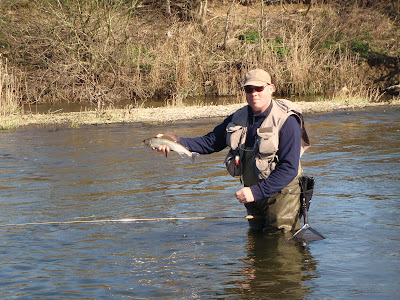
| My best from last weekend |
Firstly, I aim to visit some 'new' waters that I have not previously fished and have a list of some nice looking rivers and streams which hopefully will appear in this blog in due course.
Secondly, for me the ultimate pleasure from fly fishing is casting a dry fly upstream on a small stream in the middle of nowhere to a trout sipping flies off the surface undercover of some overhanging branches, then getting in the perfect cast and watching it take a recently tied pattern...glorious!!! But as this is a rare occurrence I intend to further explore other styles of fly fishing. One style that I am getting to grips with is the recent development of the 'European long rod/leader' approach to fishing which can really prove deadly in the right conditions.
| Fishing the 'long leader' with my 10' #3 Greys Streamflex |
A major concern and one of the biggest problems likely to be encountered this year will be the lack of rain which is already causing rivers to run well below normal and with little foreseeable rain I can only imagine some areas of the UK will suffer even more so.
Wednesday, 22 February 2012
The Molten Mono Method
Whilst watching a recent Davie McPhail tying video I picked up what I thought was a great way to attach a bead to the top of the shank of a hook as in the style of a Polyfitus Nymph.
The idea that Davie uses on one of his many outstanding YouTube videos is oulined below:
1. Double up a piece of strong breaking strain monofilament line (I've used 10lb line on a 4.5mm diameter tungsten bead) then thread it through the non-chamfered side of the bead.
2. Whilst holding the tag ends in your fingers get a lighter and proceed to slowly heat the ends.
3. Proceed to heat the mono so that it starts to melt in a ball towards the chamfered side of the bead.
4. When there is a large enough molten ball and when it has cooled down to a tacky state (this step comes easy with a little practice) use the back of your thumb nail and press the tacky ball of mono into the bead filling up the recess.
![]() |
| Polyfitus Peeping Caddis |
1. Double up a piece of strong breaking strain monofilament line (I've used 10lb line on a 4.5mm diameter tungsten bead) then thread it through the non-chamfered side of the bead.
2. Whilst holding the tag ends in your fingers get a lighter and proceed to slowly heat the ends.
3. Proceed to heat the mono so that it starts to melt in a ball towards the chamfered side of the bead.
4. When there is a large enough molten ball and when it has cooled down to a tacky state (this step comes easy with a little practice) use the back of your thumb nail and press the tacky ball of mono into the bead filling up the recess.
5. When the mono solidifies you end up with the bead firmly attached with a couple of tag ends ready to tie onto the top of the hook.
This method of attaching the tungsten bead on top of the hook naturally makes the fly sit in an upside down position on the river bed and allows the bend of the hook to face upward.
Tuesday, 14 February 2012
It's Not All About Catching Fish...!!!
My first trip out fishing after a couple of weeks of bad weather was a visit to the River Ithon in Mid-Wales on Sunday.
On arriving at our chosen beat on the river myself and fishing buddy Nick was greeted by a couple of coarse fishing anglers just heading off down the beat with their trotting gear...not what we wanted to see as this beat was barely enough for two angler.
So it was back in the car and a short drive further downstream to a beat I had only fished a couple of times before early last summer so we had no idea what the winter grayling fishing would be like.
River as it looked on Sunday
The river looked totally different from when I'd last seen it with more than a lot more water running through it, so the set up included a couple of fairly heavyweight tungsten flies to get down quick.
Although conditions weren't perfect there were pools on this beat that looked like they should have grayling queueing up for our flies...but not so! After an almost fruitless search through the whole length we had only managed to connect with a couple of proper fish which both threw the hook, other than that it was a couple of small grayling which Nick found in a deep pool.
Before we headed back home we dropped back into our starting pool where Nick was rewarded with two nice grayling within the space of five minutes, me...I was rewarded with my first blank for quite a while!
On arriving at our chosen beat on the river myself and fishing buddy Nick was greeted by a couple of coarse fishing anglers just heading off down the beat with their trotting gear...not what we wanted to see as this beat was barely enough for two angler.
So it was back in the car and a short drive further downstream to a beat I had only fished a couple of times before early last summer so we had no idea what the winter grayling fishing would be like.
River as it looked on Sunday
Photo of the same bit of water taken last May
Although conditions weren't perfect there were pools on this beat that looked like they should have grayling queueing up for our flies...but not so! After an almost fruitless search through the whole length we had only managed to connect with a couple of proper fish which both threw the hook, other than that it was a couple of small grayling which Nick found in a deep pool.
Before we headed back home we dropped back into our starting pool where Nick was rewarded with two nice grayling within the space of five minutes, me...I was rewarded with my first blank for quite a while!
Friday, 10 February 2012
Clothing To Keep The Cold Out
One thing that makes fly fishing enjoyable is being able to go out in the elements and withstand anything mother nature has to throw at you and still enjoy your days fishing.
A good set of waterproofs and a well layered construction underneath can keep you warm throughout the day, often leading to you being called everything under the sun as your the last one off the water!
By layering up I don't mean throwing everything you own on and setting out fishing. Less layers with a good technical performance are more equipt at keeping you warm than 6 layers of t-shirts or 3 pairs of socks. A 3 layer system is the most effective. Base, Middle and Outer depending on the conditions your experiencing. Below is the perfect way to insulate your body to protect you against anything thrown at you.
Base Layer
Your base layer is the first layer of your winter protection and is the layer next to your skin. Getting your base layer correct is the key to retaining heat in any weather conditions. A quick moisture wicking material is ideal for keeping your garment from holding moisture such as sweat. This is vital for keeping you warm. It means if you sweat while fishing or walking your base layer will remain dry allowing you to stay warm.
The ideal base layer materials are merino wool, silk, polypropylene and other various synthetic fibres. If there is one rule to follow - never, ever use cotton as a base layer. It will not matter what you put over the top in an effort to keep warm, you will remain wet and cold.
You may wear light-weight, mid-weight, or heavy-weight base layers depending on the outside conditions. Use light-weight base layers for mild conditions and heavy-weight base layers for extremely cold weather conditions.
Mid Layer
The main purpose of the mid-layer is to provide your body with insulation. Its aim is to trap the warmth coming from your body, by trapping the warm air around your body. So make sure all your items fit correctly or your warm air will escape.
Tucking your layers in will help too! Your mid-layer goes over your moisture wicking base layer. You may need any number of mid-layers depending on the temperature you are experiencing.
A mid-layer should be thicker than a base layer. Again, do not use cotton it simply does not insulate as well as other fabrics. Some good examples of mid layers include a mid weight fleece or polyester.
You will find using several thinner mid-layer articles, like a vest, sweater or jacket, is better than one really thick and heavy garment. It will provide you with more flexibility if the weather change
Top Layer
This should be your thickest insulating layer and your warmest layer. There are many outer layers to choose from. When choosing an outer layer consider the following:
Temperature - Weight - Style - Purpose
An outer layer maybe a heavy fleece, a down jacket or soft shell. This is the layer that most people will see and will be in most of your photos when you get home.
A shell is your final layer. It is very important as it protects you from perspiration and wind. Essentially it is your water proof, wind proof layer which keeps all of your other layers warm and dry. Again there are many features of shells to be considered - weight, durability, length, warmth and waterproofing.

It can also be a good idea throughout the winter and the start of spring to use an additional 'bib and Brace' thermal underwear, which can be worn on top of your mid layers, putting the fleece and shell outside to retain the heat produced. These add much needed cold protection to your legs whilst wading in icy cold river, sitting still in a boat or on the bank of a still water.
Airflo Thermo Skin Bib and Brace has an effective wicking system which effectively transfers moisture away from the skin. The full body thermal suit retains heat from your ankles to your neck, paired with an effective fleece the cold will be sure to stay outside!
| The correct thermal layering is essential when deep water wading in winter! |
A good set of waterproofs and a well layered construction underneath can keep you warm throughout the day, often leading to you being called everything under the sun as your the last one off the water!
By layering up I don't mean throwing everything you own on and setting out fishing. Less layers with a good technical performance are more equipt at keeping you warm than 6 layers of t-shirts or 3 pairs of socks. A 3 layer system is the most effective. Base, Middle and Outer depending on the conditions your experiencing. Below is the perfect way to insulate your body to protect you against anything thrown at you.
Base Layer
Your base layer is the first layer of your winter protection and is the layer next to your skin. Getting your base layer correct is the key to retaining heat in any weather conditions. A quick moisture wicking material is ideal for keeping your garment from holding moisture such as sweat. This is vital for keeping you warm. It means if you sweat while fishing or walking your base layer will remain dry allowing you to stay warm.
The ideal base layer materials are merino wool, silk, polypropylene and other various synthetic fibres. If there is one rule to follow - never, ever use cotton as a base layer. It will not matter what you put over the top in an effort to keep warm, you will remain wet and cold.
You may wear light-weight, mid-weight, or heavy-weight base layers depending on the outside conditions. Use light-weight base layers for mild conditions and heavy-weight base layers for extremely cold weather conditions.
Mid Layer
The main purpose of the mid-layer is to provide your body with insulation. Its aim is to trap the warmth coming from your body, by trapping the warm air around your body. So make sure all your items fit correctly or your warm air will escape.
Tucking your layers in will help too! Your mid-layer goes over your moisture wicking base layer. You may need any number of mid-layers depending on the temperature you are experiencing.
A mid-layer should be thicker than a base layer. Again, do not use cotton it simply does not insulate as well as other fabrics. Some good examples of mid layers include a mid weight fleece or polyester.
You will find using several thinner mid-layer articles, like a vest, sweater or jacket, is better than one really thick and heavy garment. It will provide you with more flexibility if the weather change
Top Layer
This should be your thickest insulating layer and your warmest layer. There are many outer layers to choose from. When choosing an outer layer consider the following:
Temperature - Weight - Style - Purpose
An outer layer maybe a heavy fleece, a down jacket or soft shell. This is the layer that most people will see and will be in most of your photos when you get home.
A shell is your final layer. It is very important as it protects you from perspiration and wind. Essentially it is your water proof, wind proof layer which keeps all of your other layers warm and dry. Again there are many features of shells to be considered - weight, durability, length, warmth and waterproofing.
It can also be a good idea throughout the winter and the start of spring to use an additional 'bib and Brace' thermal underwear, which can be worn on top of your mid layers, putting the fleece and shell outside to retain the heat produced. These add much needed cold protection to your legs whilst wading in icy cold river, sitting still in a boat or on the bank of a still water.
Airflo Thermo Skin Bib and Brace has an effective wicking system which effectively transfers moisture away from the skin. The full body thermal suit retains heat from your ankles to your neck, paired with an effective fleece the cold will be sure to stay outside!
Subscribe to:
Posts (Atom)


